Knife Skillz: Dicing a Tomato

July 20th, 2008 by katie

Cutting a tomato was the bane of my existence. I came from a family that used tomatoes as condiments-slices on burgers or sandwiches, wedges with hotdogs or salads. I married into a family that uses tomatoes as condiments, but in the form of salsas, pico, and guacamole. I suddenly had to figure out how to transform a big squishy ball of liquid into tiny square pieces. I was miserable and embarrassed until someone finally explained to me this: planks then dice. The key to dicing, be it potatoes, peppers, onions, tomatoes or any other ingredient, is to first cut into planks (long vertical strips) then turn 90° and cut into squares.

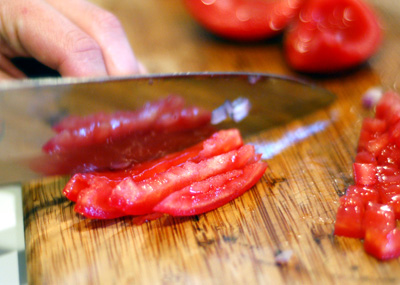
Tomato planks

Tomatoes are unique because the seeds are so troublesome. When making sauces and other liquidy tomato based foods, feel free to keep the seeds for flavor and liquid content. For any dish you need diced tomatoes for, on the other hand, you want to seed your tomatoes first so you can work directly with the flesh. Quarter the tomatoes and scoop out the seeds using a spoon or your fingers. Then flatten the flesh against the cutting board and slice into several strips, about the thickness you want your final dice to be.

Here I demonstrate how to slice off the tip of your thumb.

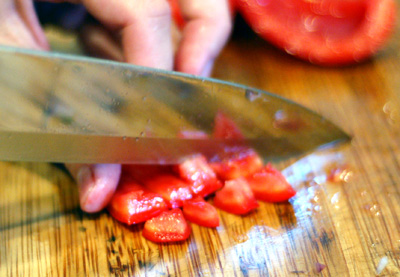
Finally, rotate your slices (planks) so they are horizontal and you are slicing the longer pieces into smaller uniform squares.

Follow along with the Knife Skillz Series.

Posted in Tips and Tricks having no comments »

Wine and Cheese Taste Test: Camembert Edition

July 18th, 2008 by katie

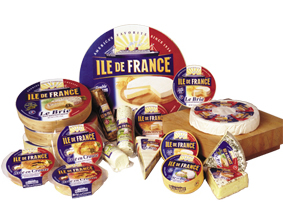
Ile de FranceA few weeks ago the folks at Ile De France contacted me to see if I’d like to taste and review some of their cheese. Because I’ll take free food any way I can get it, I said of course I would like to taste your free cheese. I picked the Camembert because I wasn’t familiar with it and thought I could broaden my cheese horizons. Their website recommended pairing it with a Louis Jadot Beaujolais Villages ($11), which they described as “powerful, yet fruity,” which by the way is exactly how I like my men. Perfect, I was already looking forward to it.

Before I get into my opinion of their Camembert, I first want to mention a few things about their website. My first stop on the site was the pairings section, because my favorite way to experience new cheeses is balanced with the perfect wine. The Chaos household tends towards hard, aged cheeses so I have found the pairings information extremely helpful considering I don’t have a clue as to what to pair with soft, rich, creamy cheeses like the ones Ile de France specializes in.

Next stop, Recipes. I love browsing new recipes and learning about creative ways to use ingredients I am unfamiliar with, like soft cheese. I thought the video recipes were interesting, since watching someone make a recipe goes along way towards boosting my confidence in trying out a new recipe myself. My final stop on the Ile de France website tour: their Wellness page. I learned that soft cheese while seemingly richer and therefore fattier than hard cheese actually has fewer calories and fat per ounce due to the higher moisture content. Of course, I like cave-aged hard cheeses that are so dry they’ve built up lactic acid crystals and are probably 1,000 calories of pure fat per ounce. So rest assured, I’ll be switching over to triple-cream brie, you know, for health reasons. But seriously, the trick to cheese consumption is to find powerful, flavorful cheeses that satisfy you after a single ounce.

Which bring us to the question: how does Ile de France’s Camembert satisfy?

In the interest of fair play I asked the wine guy to suggest an alternate pairing and also picked up an alternate brand of cheese from the deli. The second wine pairing was a Rutz Cellars Russian River Valley Cuvee Chardonnay ($14) and our other camembert was by Delice de France. Thusly, we embarked on our own mini wine and cheese tasting.

The wines: The Beaujolais was a good wine choice to compliment the creamy cheese. It is somewhat dry but fruity and is quite crisp tasting for a red wine. I definitely tastes best chilled. The rich creaminess of the Camembert requires a wine with some acid which both the Beaujolais and chardonnay had. The chardonnay was our favorite for the night. It was rich (and dare I say buttery? Not really sure I know what I am talking about…) with only slight acid and went wonderfully with the tang from the cheese.

The cheeses: The Delice de France cheese was texturally quite different from the Ile de France cheese. It was creamier with less structure and the flavor was quite a bit more intense from the offset. The Ile de France cheese was milder, with a stronger finish. Both cheeses, although creamy and rich, had a lighter-yet tangier and nuttier-flavor than Brie. The Delice de France was our favorite for flavor and texture. We were easily satiated by the one ounce mark. Unfortunately, the cost-at over a $1 per ounce-would make it difficult to enjoy this cheese very often. The Ile de France was the better budget choice at about 75¢ per ounce. It is also more widely available: I was able to locate it at all 4 of the major grocery stores in our area. One advantage the Ile de France cheese had over the Delice de France cheese: it’s firmer structure made removing the rind much easier. I know, I know-real connoisseurs eat the rind. Well, the dog then is quite the cheese connoisseur because he gets all the rinds at my house. Sorry, I just can’t stand the texture or taste; I like my creamy cheeses creamy.

The verdict: Ile de France’s Camembert cheese is the winner in convenience, price, and availability. The flavor is less intense-which means I could easily put away several ounces, ack!-than the more expensive brand which I would occasionally splurge on instead. Both wines went very well with both cheeses, the chardonnay being our favorite. This was a really fun experiment and I encourage anyone who is interested to try it yourselves and let me know what you think!

This is not a paid advertisement. In fact, I spent $32 on wine and cheese that I will happily accept reimbursement for. Anyone? Anyone? If I do any more cheese reviews I might have to ask someone to buy me one of these in exchange. I have been familiar with the Ile de France brand for some time because the grocery stores in my area carry it in their deli section. If you aren’t able to find it in your area they are available online as well, and it comes in a cute package.
Posted in Reviews, Wine having 3 comments »

Knife Skillz: Minced Garlic

July 16th, 2008 by katie

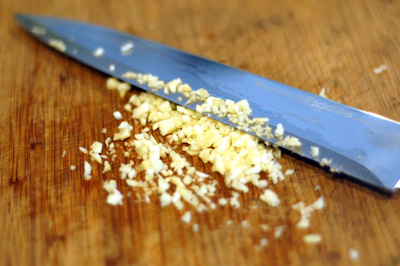
minced garlic

I have always unashamedly bought the jarred minced garlic. It was easy and fast and I figured it didn’t matter. And, really, it doesn’t. The flavor is duller but you can compensate by using more. However there is something about mincing a fresh clove of garlic that just screams, “Cooking! We’re cooking here!” Its the dull, chop chop chop on the cutting board, the comforting smell wafting through the kitchen, and the knowledge that a delicious, flavor-packed meal is being prepared from fresh, whole ingredients.

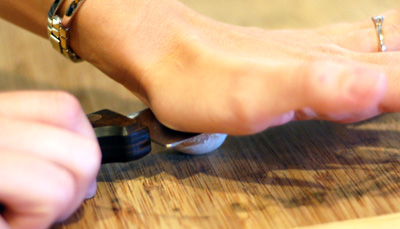
Mincing a clove of garlic is not difficult or time consuming. The advantage over the jarred garlic-besides the seriously amped up flavor-is that you can mince it as coarsely or finely as you’d like. As a kid, my job during dinner preparations was to peel the onions and garlic. I remember agonizing over the tiny paper wrapped cloves seemingly permanently enclosed. Well those days are no more. The fastest and easiest way to unwrap a garlic clove: use the hilt of your knife to smash it against a cutting board. Place the flat of your knife over the clove then use the heel of your hand to give it a good smoosh-paper and all. Once your clove is split open, you’ll find the paper peels right off with no resistance.

Smashing the garlic with the flat of the knife blade

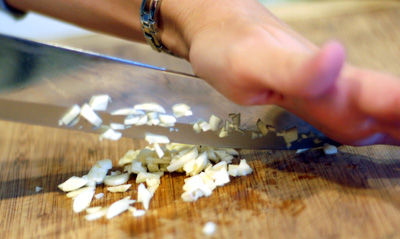
Smashing the garlic clove also gives you a head start on the mincing process. Using your palm to anchor the knife tip, rock your blade over and over the garlic chopping it into smaller and smaller pieces. As your garlic spreads out, stop and pile it back up, then continue mincing until it is as fine as desired for your recipe.

Mincing the garlic, rocking the knife blade by anchoring the tip with your palm

Depending on the recipe, sometimes you would prefer not to have chunks of garlic present. You can transform your minced garlic into garlic paste by sprinkling a bit of kosher salt over it then using the flat of your knife again to scrape the minced garlic back and forth. The kosher salt flakes act as an abrasive and will grind your garlic bits into a smooth paste. This is great to add to pasta or pizza sauce, or mix with butter and spread over hot crusty bread.

Follow along the Knife Skillz series.

Posted in Tips and Tricks having 3 comments »

Indulgent Strawberry Cheesecake Ice Cream

July 14th, 2008 by katie

I scream...

Ok folks, this recipe is not categorized as easy or fast. It requires equipment you may or may not have and trying some new techniques you may or may not have been exposed to. But if you are feeling brave this recipe IS WORTH IT. Also, it makes enough and is so sinfully rich that I usually only make it once a summer. This was the first recipe I tried when I got my ice cream maker and it was the first time I had tried many of these techniques as well. The result was impressive, delicious ice cream that really wasn’t as hard as I thought. So who’s ready to make some ice cream? Come on, let’s get fat together…

Strawberry Cheesecake Ice Cream

makes about 2 quarts of ice cream, prep time: 10 min, cook time: about 20 min plus chilling time and however long your ice cream maker needs
  • 2 cups heavy cream
  • 4 oz. cream cheese
  • 3 egg yolks
  • 2/3 cup sugar
  • 1 1/2 tsp pure vanilla extract
  • 1 10 oz. container frozen sliced strawberries in syrup, thawed
  1. Puree strawberries in syrup, if you like bits of strawberry in your ice cream reserve a few and give them a rough chop.
  2. Heat the cream in a sauce pan just until it starts to bubble, without boiling. FYI, this is called scalding the cream for future reference.
  3. In a stainless steel bowl beat cream cheese, egg yolks, and sugar until light and fluffy, about 2 minutes.
  4. Slowly pour the heated cream into the egg mixture while whisking constantly so the eggs do not curdle. Slowly = barely a dribble, stirring constantly, until you’ve gotten about half of it in, then you can actually pour. If you dump the hot cream into your creamed egg yolk mixture you’ll get scrambled eggs. If you do get any lumps, strain them out before moving on to the next step.
  5. Place the bowl over a sauce pan of water and heat the water. Stirring constantly, cook until the custard thickens enough to coat the back of a spoon. Seriously, dip a spoon in the custard and pull it back out, then draw a line on the back of the spoon with your finger. If the line stays in place, you’re good. Be sure to lick your finger, but don’t let anybody see. They’ll want to lick too.
  6. Immediately remove the custard from the heat and stir to cool so it doesn’t over cook.
  7. Stir in the vanilla and 1/2-1 cup of strawberry puree (don’t be afraid to taste test until you get it the way you like it). This should give you about 4 cups of ice cream “batter.”
  8. Cover with plastic wrap by placing it against the surface of the custard (this prevents a skin from forming) and allow to cool to room temperature. Then refrigerate several hours until cold.
  9. Process the cold custard in your ice cream maker according to the directions. If desired, stir in some of the chopped strawberries from step 1. Personally, I don’t like too many hunks of frozen strawberry in my ice cream, it distracts from the velvety texture of this stuff.
  10. Store in the freezer in an airtight container.

Your custard is done when it coats the back of the spoon, so that if you draw a line through it the sides do not run together.

TIP: Leave out the strawberry syrup and you’ll get fabulously rich plain cheesecake ice cream. You can even add little bits of graham cracker crust during the processing stage. Purchase a ready made graham cracker crust and break it into small chunks. Add the crust pieces during the stir-in stage of your ice cream processing.

Posted in Desserts having 3 comments »

About chaos

cha·os -noun 1. a condition or place of great disorder or confusion. My chaotic kitchen is the result of three kids, two adults, dog, cat, and fish, a food obsession, a wine drinking hobby, and too few hours in the day. Between trying to feed a family of five healthy, happy meals, watching my weight, saving my pennies, and staying partially sane I have picked up a few tricks along the way. So here they are: the very best tips, tricks, and recipes from my chaotic kitchen-to yours!

Blog Widget by LinkWithin